MGR Leg 4 - Cape Town to Antigua - Week 2. Cape Town to Saint Helena Island. Posted by Graham Cox.
Most of the great tradewind circumnavigators have made landfall on St Helena Island – Joshua Slocum, Harry Pidgeon, Alain Gerbault, Bernard Moitessier, and of course, our MGR patron, John Guzzwell, aboard TREKKA, the little boat that could, and the first micro-yacht to sail around the world. And now the MGR skippers, all 11 of them, aboard their ALMA Class Globe 580 sloops, join these illustrious alumni.
Renaud was the first to arrive in Saint Helena on the morning of 10 January, a little more than 12.5 days out of Cape Town, with cloudy skies and gusty winds chasing him into the anchorage. He reported that the passage had presented a mixed bag of weather, mostly moderate but unstable enough to keep him on his toes. John Guzzwell took 16 days, so this is an excellent result.
After the squall that laid CAPUCINETTE down several days earlier, the wind eased off on 08 January, though it barely slowed Renaud, just made life a little easier, I suspect. He noted, humorously, “But where did the wind go? Apart from oil, everything's okay on board.” A video he posted showed CAPUCINNETE slipping along over a smooth ocean.
He later noted, “Today I realized that I’ve now sailed the full 360° around the globe since leaving Les Sables-d’Olonne… That’s a seriously long stretch of sailing aboard CAPUCINETTE. It’s also a good excuse to finish my bottle of English Harbour Aged 5 Years Antigua rum! Cheers — santé, salut, cheers, prost, na zdrowie!”
A few hours later, he was followed into James Bay, off the main settlement of Jamestown, by Aussie Dan. In his final post underway, Dan said, “Achieving another milestone today. 200 days at sea aboard the mighty IMMORTAL GAME. It is an extra special one, as I have also just sighted land at one of the most remote islands in the world, St Helena.”
Late on 10 January, he posted, “Immigration and customs done in St Helena. A nice feed and a few pints with Renaud and Mike before catching the local ferry back to the boat for the evening!” (Mike Peckham, skipper of the Rustler 36, WHITE MALKIN, has been sailing around the world in company with the MGR fleet from the beginning He helped Adam prepare LITTLE WREN.)
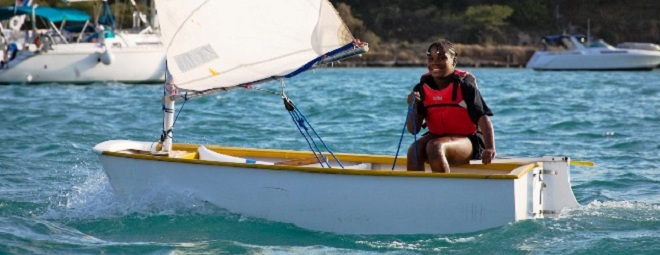
Jakub arrived just on dusk the same day, having been only 55 NM behind Renaud, to secure 3rd place for this stage, BIBI’s best performance yet. Pilar was next in later that night, with PETER PUNK just edging out Adam aboard LITTLE WREN. She was in 3rd place during the early stages of this passage, but ran into lighter winds east of the rhumb line in the second week, whereas Jakub, further west, held his breeze. Adam also inched his way past Pilar for several days, but she clawed back in the final days to secure 4th position. This leading pack of 5 boats almost had a match race all the way from Cape Town.
For a famously fair-weather passage, there have been adventures and misfortunes enough among the fleet, although also reports of benign weather for days on end.
On 07 January, Adam noted, “Finished my last eggs today. Perhaps a good thing, as I have eaten omelette for 10 nights in a row. LITTLE WREN is in great shape and enjoying being back in the Atlantic.”
On the same day, Jasmine reported, “Slower day again. NUMBATOU doesn’t do well in light winds. Warm and beautiful out here though. Hydrovane has decided to give me a problem that will need a more permanent fix when I get to land. Hard to tell if it’s that or the changing winds that are making it harder to stay in a straight line.”
On 08 January, Keri noted, “I am not sure which is the most numerous, among the phenomena sighted these past few days: The Portuguese man o’ wars we passed on calmer days; The myriad of stars in Hera’s lactic constellation (The Milky Way), spied last night before the waning moon rose; Or the outbreak of smallpox on my mainsail? I have lost count of the number of red patches applied to this sail now - but it is a miracle it still holds together. Praise be for sail-number cloth (and hot, dry days to apply it)… He noted later that he used sail-number cloth because it was light, strong, and had excellent adhesive properties.
“I am looking forward to catching up with the flock in Saint Helena,” he continued, “and telling them what a great two days they missed out on in Table Bay - chasing zephyrs and celebrating every 0.1 knot, especially when it was in the right direction!
“To reassure Jasmine, it’s the shifting winds and wave directions that elicit our current drunken meandering, at least until the trade winds stabilise again in coming days. Well, that’s my story, anyway.”
On 09 January, Jasmine’s mum, Susan, reported, “Jasmine’s wind vane steering flip-flop frame broke yesterday. The aluminium tubing has sheered near the base. She wracked her brain, tool kit and spares to find a temporary solution of a bolt inside the tube to hold the two ends aligned, then good old gaffer tape around the outside. It’s not possible (or cost effective) to get a new frame delivered to St Helena, so we’re working on getting other bits sent there to support and sleeve it properly, so it will last across to Antigua.”
On the same day, Ertan Beskardes noted, “Good morning, TREKKA happily going towards St Helena, all is well on board.” Unfortunately, that good fortune was not to last.
Josh sent an update about his kelp problem. “There was in fact four giant pieces of kelp hung up on the keel. I used the go-pro on a stick to take a peek. It was pretty rough that day and I was nervous about getting into the sea to clear it off, but it had to be done, as backing down wasn’t going to free them. I waited for a nice sunny break and climbed over the stern. I dove in, cleared the offending flora, and watched the speed jump from 1.5kt to 2.5kt - and that was before I put any sails back up! Forget a JSD or towing warps, just bring along 3-4 pieces of bull kelp to wrap around the keel when you really want to slow down.”
Eric reported, “All good on SUNBEAR, last few days a lot of showers and cloudy. We are back in a little current at the moment, and starting to make good progress again. Looks like Monday ETA now, after the light winds.”
On 09 January, Christian said, “After two calm and very slow days, we got better winds today. More sunshine, too, so I’m trying to get some of it into my batteries. The waves are bigger, so the boat is moving quite a lot, but it’s very nice sailing. Had a shark swimming right next to the boat - maybe I look tasty, or at least well-fed. Still have some fresh fruits left.”
On 10 January, there was bad news from an unusually disgruntled Ertan, though with very good cause. “My expensive sail repairs (R11,400) from Ulmann Sails in Cape Town did not last long.” He was not very happy with their service in general. “A7 returned exactly the same condition as it was sent - not looked at but charged for; A5 - 4 round stickers, but they forgot to stitch the edges; mainsail repair, well - great job.” (The mainsail had a major tear in the upper panels.)
On 10 January, Susan reported, “Jasmine has about another 130 NM to go to St. Helena. The other exciting news is that she has passed the same longitude as her home town, Thirsk, so has officially been all the way around the world.
“Last night the Hydrovane flip flop frame broke off completely (so that’s now two breaks in the frame). It was trailing in the water and meant Jasmine lost her course for a while. She was able to retrieve it as she already had it tied to the main part of the unit. It took 3 hours to try and repair it, resettle the boat to the right direction, and set up the autopilot to take over for a short while. The autopilot is not something Jasmine uses much, and she only has one, but it’s useful for this situation.
“None of the Mini Globe Race sailors have been looking forwards to anchoring at St. Helena, and the government moorings were condemned and decommissioned some time ago. Over Christmas, Jasmine was featured on BBC News; this was seen by the Head of Tourism on St Helena, who got in touch with Jasmine. He put us in touch with Kees, the commodore of Saint Helena Yacht Club, who has been working hard over the last 10 days to put 6 moorings in for the fleet, each with a 20kg Bruce anchor, 30m of 10mm chain, and 24mm rope. The Tourist office is also hosting a meal for all the skippers on 14th January.”
On 10 January, Kerry Waugh posted an update, along with photos of Adam pretending to be a bit manic (can’t fool us, Mr Cool), and his hard-done-by rations, which just happened to include roast goose! “Land Ho is expected soon, as LITTLE WREN is less than 50 NM from port. With rations becoming very basic, Adam is looking forward to some fresh food and a well-deserved beer.”
In a later chat, Adam said the roast goose, canned in Singapore and purchased in Cocos Keeling Atoll, wasn’t exactly confit de canard - it was barely edible. Along with the canned buffalo meat he bought at the same time, and tinned sardines, it has joined the list of banned foods on LITTLE WREN! In the picture of him looking manic, he has a quail’s egg in his mouth, which was a gift from Jasmine, who’d noted his fondness for eggs.
Speaking of food, he said, “I bought quite a lot of biltong in South Africa, and that's a nice snack. I always buy two-dozen eggs, and so I had an omelette nearly every night, for as long as they lasted, to which I added fresh tomatoes plus an onion. That kept me going for at least 10, 11 days. And I had my quail's eggs, with a bit of salt and pepper.”
He has lost a little weight since starting the MGR. “When I left Portugal, I weighed 77 kilos, but by the time I got to the Marquesas, I was down to 68 kilos. Now I’ve fattened up a bit and am back to 72 kilos.” Must be the quail’s eggs.
From Saint Helena, he reported, “We had a very straightforward passage from Cape Town. We got a bit of a battering the first night, and it was a bit of a rude awakening. 36 hours later, I replaced the jib and triple-reefed mainsail with a couple of the smaller spinnakers, and that was fine for a day. And then I had 5 days non-stop with my A3 up day and night, which I hadn't used an awful lot, and it was a real joy.
“The sea-state was benign, and the A3 works really well when you haven't got a lot of top-of-the-mast movement. It was really relaxing sailing - unbroken blue skies, no squalls, and I settled into the passage quicker than I ever did before. I was obviously checking things every hour and a half or so during the night. Occasionally the boat would round up a little bit, but came back very quickly.”
He used his Raymarine tiller pilot for much of this passage, as the apparent winds were so light. “I think that helped me hold a straighter course. I used it about 80% of the time. I'm sure this was part of the reason why I sailed quicker this time. I lowered the gain on it. I have two tiller-pilots, and swapped them over every 12 hours.
“Things got more testing during the second half of the passage, as the winds picked up and we had to work a little bit harder. The sea-state picked up more than anything. LITTLE WREN’s speed dropped a bit compared to some of my other friends but still held up. What I expected to be a 3-week passage ended up taking something like 13.5 days.
There were some squalls, but they were not as aggressive as we've had in the past. There were gusts of up to around 30 knots, but they didn't last as long. Inevitably, most of them seemed to come at night. But as I've gone on, my confidence in using the continuous furlers, and my technique using them, has improved. I can whip in an A5 very quickly now - it takes all of 10 seconds.
“So, I’m sailing a little braver, I guess, with a bit more sail up, which maybe accounts for some of our increase in speed. The wind was about 12 to 16 knots from behind on average, so it was a good passage for experimentation.
“After I dropped the A3, I moved the A5 forward, using the A3’s halyard, which allowed me to bring the A7 back out. From that point on, I used a combination of either A7, A5, or jib. I had my mainsail covered for almost the whole time, which I was really pleased about, because that's the most vulnerable sail that I have.”
He has not started thinking about what comes after the MGR, and says he is not yet tired of this adventure, or of sailing in general. “I felt exhausted when we got to Torres Strait and Cocos Keeling - I wouldn't say fed up, just emotionally and physically done in. Since then, I think I've probably become more confident with the sailing, the boat's going faster, and I'm happier. Mind you, I wouldn't want you to put me back on the start line, that's for sure.”
He does not have a lot of work to do in Saint Helena, and is staying ashore with Kerry, who flew in last Saturday. “I had some little repairs to do on my sails, which I did the morning after arrival. I had to wait eight hours on the boat for customs to come and pick me up. So now I've got nothing to do other than getting a bit more water and some fresh food.”
He came into the anchorage at Saint Helena in the dark, after sighting the foreboding cliffs on the eastern side of the island in the late afternoon - Napoleon was said to despair at the sight of them - which may account for Adam’s unexpected response to making landfall. “I got terribly nervous coming in,” he said. “I can't quite work out why, because there are no reefs. It was probably the most straightforward approach I’ve made on this trip, and I've done most of my approaches in the dark.
“I went through the finish line and then had to come back up. The sea was flat in the lee of the island - a little bit of roll - but the engine worked, and I was able to motor the last mile to the moorings. I was making three knots, so it was very comfortable.
“I've got a feeling that either Dan or Renaud shone a torch for me. Dan had left his AIS on and told me that there was a mooring in front of his boat, which was very helpful. I've got a very strong torch, so I picked out the mooring in front of IMMORTAL GAME and just drifted in and picked it up.”
He is meeting with the Governor of Saint Helena, Nigel Phillips, this week. “I sent an email to the Governor on my way across, just to let him know that this merry band of men and women are arriving, and I'm having a coffee with him later in the week.”
Adam is back on English soil for the first time since he flew out of the UK on the 4th of December 2024. “And of course, I was telling everybody in Cape Town that I would look after them here, and it'll run like clockwork because we're back in Britain. We all sent emails to Saint Helena Customs and Immigration, with our paperwork attached, but when we went ashore, for some reason or other, they couldn't find our emails, which was a bit embarrassing.”
Christian sailed in on the morning of 11 January, after a passage of around 13.5 days, though he noted, “I didn't see any sun, as it was really cloudy and raining this morning. And the wind died down in the lee of the island. The last three or four days have been a bit slower for me, though yesterday and the night before was good. Heavier boats like ARGO can go really fast in stronger winds., but if it's light, unfortunately, Jakub, Pilar and Adam are much faster than I am.”
That was the order in which they arrived at Saint Helena, with Christian securing 6th place for this leg, but he was uncertain whether Jakub’s fast passage might have squeezed ARGO out of 6th place overall.
“Most parts of the passage were just great. We had some cloudy days where I was struggling to keep my batteries charged, but we had wind most of the time.
“One day, the A3 just blew up in 12 knots of wind, even though I haven’t used it that much. The sailcloth is just not strong enough for this kind of voyage. I didn't fix it so far because there’s quite a long tear in it. I'm not sure if I will be able to do it even on shore, but I'm going to try.
“Also, my right shoulder became really sore. There were a couple of days where the motion of ARGO was really bad. I don't know if I did some special movement or whatever, but the pain was even worse than in the left shoulder. The left one is where the tear is confirmed, so I'm a bit surprised. It's better now. At the moment, I'm feeling quite good.
“There are not many choices to get an apartment here or a hotel, and it's just too expensive, so I'm going to stay on the boat, even though it is pretty bumpy out here. But that's the way it is. Sometimes it's completely calm, and then from one second to another there's a gust coming from over the mountains.
“After I took the mooring this morning, I fell asleep immediately. I don't remember what I wanted to do, but just went into my bunk and fell asleep without setting the alarm. I was woken up by Pilar’s voice. There was a ferry coming to take us to do customs and immigrations. It is not possible to clear in during the morning because the officials are usually at the airport.”
This is a major change. Before the airport was completed in 2016 (first commercial flights commenced the year after), shipping was king on Saint Helena Island.
“Once we were cleared in, we went to the yacht club and chatted to the locals. We just had a short dinner and I'm back on the boat now. The ferry will run after dark, weather permitting. You have to make a special booking, and it's twice the price than during the day, but it is still much cheaper than it was in places like Thursday Island and Cocos Keeling, so getting back and forth here is not a problem. We work together to make group bookings.”
Getting on and off the ferry is famously challenging when the swell is pumping, which it sometimes does in this anchorage. In earlier times, it took a lot of skill to row ashore in your yacht tender, scramble onto the steps on the top of a swell, and haul the dinghy up behind you. Quite a few people got soaked. The ferry makes it easier, though there are still challenges involved.
“Today was very calm when we came to the steps, but they have these thick ropes there to hang onto, and sometimes you would really need them. The trickiest part is to get their boats alongside of our boats, because the 580s are moving a lot in the waves.
“I'm really happy with my mainsail repair. I basically copied what Renaud did with his mainsail. Of course, it's heavier, but at least it will hold. UK sailmakers in Durban did a great job. It's too bad that I ripped my A3, because that's going to be difficult to repair. The tissue is so worn out I doubt that any repairs I do will be good. I think it will be damaged again on the next passage.
“But from that you can tell how damaged the rest of the sails are, or that they are not strong enough, because I don't fly my A3 that much. I'd rather fly my two A5s. They have been repaired a couple of times, as well. One is a bit newer, because I only used it for the MGR - I used the other one all the way from Portugal.
“The jib has been reinforced like my mainsail, so I'm not worried about going upwind. The A7 is pretty much in its original condition - there's just been a couple of repairs on the foot of it so far. I don't use the A7 so much. I prefer having the wind from the stern so that I can fly the A5s - that's when I'm fastest.
“Most days, I was able to do about 130 NM. I used the WindPilot usually, and hand-steered when there were stronger winds. If I'm awake, or well-rested enough, to hand-steer, and it's just at the point where the WindPilot is not able to handle the boat, then we can go pretty fast. Those are the conditions when ARGO can be the fastest boat in the fleet.
“There were currents from the side sometimes, but it was not too bad. During the last week it was a bit gusty, before that it was quite stable. The worst night was the night when we were leaving Cape Town. The sea-state was really confused, we had quite strong winds, up to 30 knots, and I was even a bit seasick, which I didn't experience since Lagos in Portugal. But on the second night I was good.
“I really enjoyed being back in the Atlantic. The water was getting more and more blue the further north we came. We had beautiful sailing days with sunshine in the first week. Second week was a little bit cloudy but still good sailing conditions.”
Christian was one of those who tangled with kelp. “I was questioning myself why Adam was going so fast, and it was just by chance that I found out why. I usually pee in a bottle, but on this day I didn't. I was kneeling on the cockpit seat at the transom, and I looked down and saw just a few centimeters of the kelp sticking out the back of the boat. The thick part was on the other side of the keel, and the long stem was dangling under the hull.
“It was difficult to get rid of. I had to slow the boat completely down until ARGO was drifting sideways, then I was able to grab it on the windward side and almost pull it out, but it ripped off. The thick part came out on the other side of the boat after that.
“From then on, I checked regularly, but there was another night where I had a good night's sleep, and I caught some kelp again. I was a bit worried whether it infected the boat with barnacles, because the kelp was full of goose-like barnacles.
“During my stay here, I will clean the boat. The silicon foil is doing a great job and I can get rid of barnacles easily. Because it is a chine hull, you can just slide them to the edge and they drop off. But if the shell is already too hard, and if it's too big, then it is more difficult, and it can scratch the silicon foil. If you clean the foil with a microfiber cloth every two weeks, then you're good.
“I’ve just got general maintenance to do at Saint Helena, plus repair the A3 and clean the hull. Besides that, I've got no problem so far. It's a little bit different game from the beginning of the race, where there were things to repair in almost every stopover. So, this time I can see some of the island. That's what I missed in many places where we've been so far.”
Jasmine was next in. Her Mum reported, “Jasmine arrived in St Helena at exactly midnight, after 1705 miles from Cape Town, which took 14 days. It was pitch black for her arrival, and the initial plan was to tie onto SY MANU, a 50ft yacht skippered by Alejandro Alec Hughes Pardo, who she’d met in Hout Bay, S. Africa, until daylight, then pick up the extra mooring very kindly prepared by Kees from the Saint Helena Yacht Club. After only a short while, conditions changed and it wasn’t safe for either boat, so Jasmine moved over to the mooring. Things still didn’t quite go smoothly, and she ended up with the mooring rope tangled round the keel, and the buoy underwater. Jakub helped sort it out in the morning with a swim. The buoy scraped off a bit of antifoul but everything’s ok”
Eric and SUNBEAR arrived the next morning. The following day, he noted, “Yesterday was quite a torrid day. I was very tired of course and arrived at the anchorage at 0400. After crossing the line, I thought I'd anchor a bit further out and then move in closer first thing in the morning. I anchored in the area where Kees, the yacht club guy, had marked where it was safe to anchor.
“When I went to pull the anchor up at daybreak, I couldn't lift it. I arranged through Kees to get a diver to assist, but had to go ashore and clear Customs before he was available. Then I got the water taxi back to the boat, and found that it had drifted a good 100m. I tried to pull the anchor up again, and still couldn't. And then, blow me down, I went below to do a few things, and five minutes later came up and I had drifted another 300 metres, out towards the open sea.
“The diver came aboard and he couldn’t pull the anchor up either. Then we wrapped a line round the anchor and he towed SUNBEAR back into shallow water. We disconnected the boat from the anchor line, and I just drifted while he towed my ground tackle into a safer spot and reset the anchor. Then he came back and towed me in and hooked SUNBEAR back onto the line.
I still don't know whether the anchor was snagged, or whether it was just the extra weight of chain that made it hard to retrieve. The water was really deep, about 35m, maybe even more after we dragged. I had to go ashore then, and the diver was busy, so I don’t know whether he came back later and dove on my gear. I need to talk to him about that because I want to know what's going on.”
SUNBEAR is now anchored in about 15 metres, so hopefully the anchor will be easier to retrieve when Eric departs for Recife.
“I really enjoyed the trip up from Cape Town. The first night was a bit lumpy, but after that, we had four days of pristine sailing. I was loving it, beam-reaching with the kites up - really lovely weather, flat seas.
“Then the next week it started getting overcast, drizzly, and the sea-state was shocking, very bumpy, making it hard to sleep. I think that's why we're all tired. We had quite a lot of sleepless nights.
“I had a good tussle with Jasmine. I was sort of keeping in front of her, and then she'd come back at me at night, and then vice versa. It was quite funny. One day I had the A3 up, while she had her A5 and A7, and I put 20 miles on her. I went past her at nightfall and she freaked out. She texted me and said, ‘What have you got up with that A3? I can't get my boat to go any faster than 4.3 knots.’ So, I said to her, ‘You've got to get the right wind angle for the A3 to fly really well.’ Anyway, she caught me again the next day. We were just leap-frogging each other there for a while.”
Eric used his A3 in the lighter stuff, and the A5 and A7 poled out wing when the wind freshened. He reefed down at night, however, which was when Jasmine sneaked past. She would fly her A5 through the night.
“The problem for me,” Eric said, “is that my A5 is getting very tired. It's the original one from Michael. My sails have done about 3,000 miles more than some of the other boats. Sometimes I run the triple-reefed mainsail and the A7, especially at night, and other times, if it's blowing, I'll take the main down completely. I used to run the triple-reefed main a lot, regardless. Sometimes I still do that in different conditions, as I feel it balances the boat better and you can get a bit more power.
“But other times when it's a bit lighter, I like just like the A5 and the A7 on their own. I think they feel better, and you get a bit more boat speed and you save your main a bit.”
He does not put the sail-cover on his mainsail when it is furled. “It's handy to have your triple-reefed mainsail ready to go up when you see a squall coming. You might have an A5 and an A7 up, and you want to get rid of them until the squall goes through. You can hoist the reefed main, drop the kites at the last minute, and then roll out the jib. Otherwise, when you drop the kites, you've got nothing up at all, and you lose boat speed. You can quickly go to a triple-reefed main and the headsail and still be doing five knots in a squall.”
SUNBEAR’s Hydrovane steered the whole way. “I hardly use my electric tiller-pilot. It's a very old one - it's pretty sad – and it makes a lot of noise and groans. The Hydrovane works pretty good in most conditions.”
Eric looked a bit tired in the videos he posted on this passage, and may even have fallen asleep briefly in one. “Yeah, I thought I'll make a couple of real-life ones on the 580 - it was a bit of fun. I'm still tired, although I slept well last night. When I had lunch with Renaud yesterday, he looked tired too. Of course, he's got the whole fleet at him now, they're all going so quick, which is what we expected, didn't we?”
Eric was one of the few who reported wild life (apart from Christian’s amorous shark). “I saw some big humpbacks jumping around out there. One day there was quite a big one - I've never seen one as big - and he was having a party. He breeched about six times, and was throwing his big tail fin up in the air. I took a photo, but it was a fair distance away. And the last day coming in, there was a whole heap of dolphins jumping around the bow.”
Keri was philosophical when reflecting on ORIGAMI’s position. “I am where I am because I refused to use my engine. We all knew at the start that we had to get west quickly, that you could get into a good 25 knots of breeze from the southeast about 5 NM out. But without the engine, I couldn't get west at all. I was trying to go a bit further offshore, to clear a little bit of the wind shadow, or at least feel if there was any sort of movement there.”
“All the Cape to Rio guys the day before, and the Commodore even, that morning at the Royal Cape Yacht Club, said you need to go on the mainland side of Robin Island. So, I had that in the back of my mind, and the breeze did fill in on the right, but it was relatively short-lived. I think what I should have done was just stay in it and hug the coast, accepting that I was sailing into the high, then cut across later. That would have put me about a day behind, not two days.
“But it was a lovely bit of tactical sailing in terms of chasing every zephyr and getting excited about every 0.1 of a knot of boat speed. Once I found the breeze, it's been very much a milk run, although I never quite got into the same weather system as the boats ahead. I was always chasing the breeze and had to work hard for very little gain. But I don't mind, that's where I am.”
Once Keri got going, ORIGAMI was often the fastest boat in the fleet, even though his course was not always parallel to the rhumb line. “We were sailing fast, but having to hunt around, looking for a faster lane, trying to seek any advantage. Even though ORIGAMI is still about 80 - 90 miles out from Saint Helena, I think I've already sailed the same distance as the leaders did.
“You end up sailing further at speed, but with notional gains. And that's always the challenge with this boat, because it's a rig with an asymmetric kite and swept-back spreaders - the whole rig is set up for high-angle sailing. If you look at the YB Tracker for the Cape to Rio race, and they're all sailing big gybe angles - it looks like they're beating downwind.
“That's what our rig's designed for, but instead we sail it in this dead-downwind running configuration, which is deeply frustrating. The rig doesn't work properly in that respect. My hat off to those that make it work well, and I think the speeds of, say, Dan and Renaud, have been very impressive at times, but I think they're much happier to sail with twin spinnakers than I am.
“If there's any sort of swell running, it's a horrible way to sail, because you're just wearing out the spinnakers. Whereas, if you keep your main up, you damp the rolling a bit, you ease the motion, but you're about 0.1 to 0.2 of a knot slower. It's been a lovely leg, but just very unvaried conditions.
“I was doing my old trick of looking at where, on Windy, for example, you'd see localised advantages and slightly more pressure, and a slightly headed angle, so that you could sail higher effectively for the same track. But they never really came to fruition. It's very easy to be seduced by the graphics and think there's a sort of consistent advantage somewhere when there isn't; or there might be, but the timing is not quite what the model shows.
“I hoped on this leg that I could still be in contention to get ahead of Dan, but I think that's out of the question. So, the challenge now is to try and hold third position overall; to stay ahead of Pilar - I think I’m still about four days ahead of her. That's probably a big enough margin, but there’s a risk that I could sit in the doldrums for quite a few days. So that will prey on the back of my mind. A little bit of luck involved in that.”
Another possible reason that ORIGAMI doesn’t sail as straight a course as some MGR boats is that Keri is using a servo-pendulum windvane. He had to use the Aries for much of this passage, or hand-steer, because he damaged his electric autopilot.
“I managed to fall onto the arm of my tiller-pilot in the really light winds and broke it. I carry a spare one, but the unit is hard-wired in because the plug isn't very good, so I haven't changed that over yet. I'll do it at anchor. This passage has all been on the Aries, or me helming long hours each day and night.
“I think a tiller-pilot would have been much better on this leg (as Adam noted – see above). It will certainly be useful when we are sailing to Recife. With some sea-states, and the fact that we're really dead-running, there's very little feedback on the Aries windvane. (The apparent wind is light to non-existent.) Because of that, there's more yawing than I'd like under the Aries, with the risk of a Chinese gybe if you're not careful.
“The vang fitting has come off the bottom of the boom again, but the vang is working hard at the moment, so I didn't want to derig it. I lashed it on with Dyneema, and that'll have to hold it until I can fix it properly at anchor. The boat's starting to show a few signs of wear in that respect, but I think a week at anchor will be plenty of time to resolve everything and catch up on some good reading.”
Like Jakub, who recently invoked that old sailor’s rhyme, ‘A stich in time save nine’, Keri repairs his sails as he goes. “That’s why my mainsail looks like it's got smallpox. I bought 2m of sail-number tape, which is a sort of very fine nylon, like Ripstop, but it has very good adhesive properties. It’s about 1.8m wide, so I've got plenty of material. It’s good in small patches.
“My sails have been consistently hand-repaired at sea or in harbour. They are holding up, but are pretty threadbare. I'm very impressed with my little Speed Stitcher sewing awl, with which you can do a proper repair, emulating a sewing machine with a bobbin, so that you've got a backing stitch and a front stitch. The only problem is you tend to use quite a thick thread, quite a thick needle, and the holes are quite big. I was a bit worried about that, but it doesn't seem to be a problem.
“My A7 is like new, as I haven't used it much. I suspect it's a slightly heavier cloth, too. The A3 is feeling a bit soft, but there's no wear on it. And the A5 is not too bad either.”
“This leg is a bit of a milk run, and I think we're going to see that all the way to the doldrums. The doldrums are going to be the next bit where there'll be a bit of opportunity to shift places. The leg after that could be a milk run too, but I suspect that is going to be more tactical, particularly considering the risk of colliding with logs in the Amazon basin, and how far offshore you stand.”
Plus, there might be more squalls in the North Atlantic trade winds, if the 2025 Class Globe Transat is anything to go by. Even the milder South Atlantic squalls allow for tactical decisions. “The clouds are not cumulus, they’re like a stratus cloud, but they bring a bit more pressure for a while, and a big wind shift, depending on which side of it you are; although it goes through quite quickly and the breeze is not significantly stronger. I might go from full main to one reef, just to keep the boat balanced if I'm on the Aries.
“I might tweak the Aries a little bit, to counteract weather helm, so I don't round up too much. I'm still sailing deep. If you're helming, you're doing this without really thinking about it, but on the Aries, it's interesting. If you don’t readjust the Aries after the squall goes through, you might gybe.
“I think it will also be interesting when we approach the Brazilian coast. I don't particularly like lightning and electrical storms - the one off of Durban was probably the worst one I've been in under sail - but there's going be quite a lot of that, and I think it will be a big contributing factor to tactics and strategy - looking for a gap to get through relatively unscathed.” (Not to mention possibly advantageous wind shifts!)
One thing is for sure, Keri ain’t done yet!
At 0400 UTC on 13 January, SKOOKUM was the only boat left at sea, with abut 40 NM to go. He noted, “Whew, the sea-state for the last week ranks up there with the most infuriating conditions that I have yet to encounter. Trying to sail north across the strong, west-setting current was exhausting. The boat only wanted to go 000° (due north) or 300° (WNW). Maintaining a course anywhere within that 60° arc was a real challenge. I am looking forward to a rest stop, although with the anchoring situation, Saint Helena does not sound like a very relaxing spot.”
Image: BIBI makes landfall at St Helena Island on 10 January, to secure 3rd place for this stage.
Graham Cox is the MGR’s official scribe and author of the acclaimed sailing memoir, Last Days of the Slocum Era.